
Menu
Close
Close
Getting a price quote for window tinting in San Antonio feels like a guessing game. One shop quotes you $199. Another says $650. Both are for “the same job” on the same car. The difference is not random; it com
es down to film type, vehicle complexity, and whether the shop is actually comparing apples to apples when they hand you a number.
This guide cuts through that. You will find 2026 price ranges for every common vehicle type, a full breakdown of what drives the cost gap between budget and premium film, and a dedicated section on Tesla tinting since we service Tesla owners regularly in San Antonio. Prices here reflect what shops in San Antonio and Bexar County are actually charging this year, not national averages that have no bearing on what you will pay locally.
One thing to set expectations on upfront: this guide does not push you toward the most expensive option. It explains what each tier actually does so you can decide what makes sense for your vehicle, your budget, and how long you plan to own the car.
The table below covers full vehicle tint jobs, all side windows, and the rear glass. It does not include windshield strips, panoramic roof panels, or old tint removal, which are separate line items covered later in this guide.
Vehicle Type | Dyed Film | Carbon Film | Ceramic Film | Approx. Windows |
Compact Sedan | $150 – $250 | $250 – $380 | $350 – $550 | 5 |
Mid-Size Sedan | $175 – $300 | $280 – $420 | $400 – $600 | 5 |
Full-Size Sedan | $200 – $320 | $300 – $450 | $430 – $650 | 5–6 |
SUV / Crossover | $250 – $400 | $350 – $500 | $500 – $800 | 6–7 |
Full-Size Truck | $200 – $350 | $300 – $450 | $450 – $700 | 4–5 |
Minivan | $300 – $450 | $400 – $550 | $550 – $850 | 7–8 |
Luxury Vehicle | $350 – $500 | $450 – $650 | $600 – $1,000 | 5–6 |
Tesla (all models) | $250 – $400 | $350 – $600 | $500 – $1,200+ | Varies |
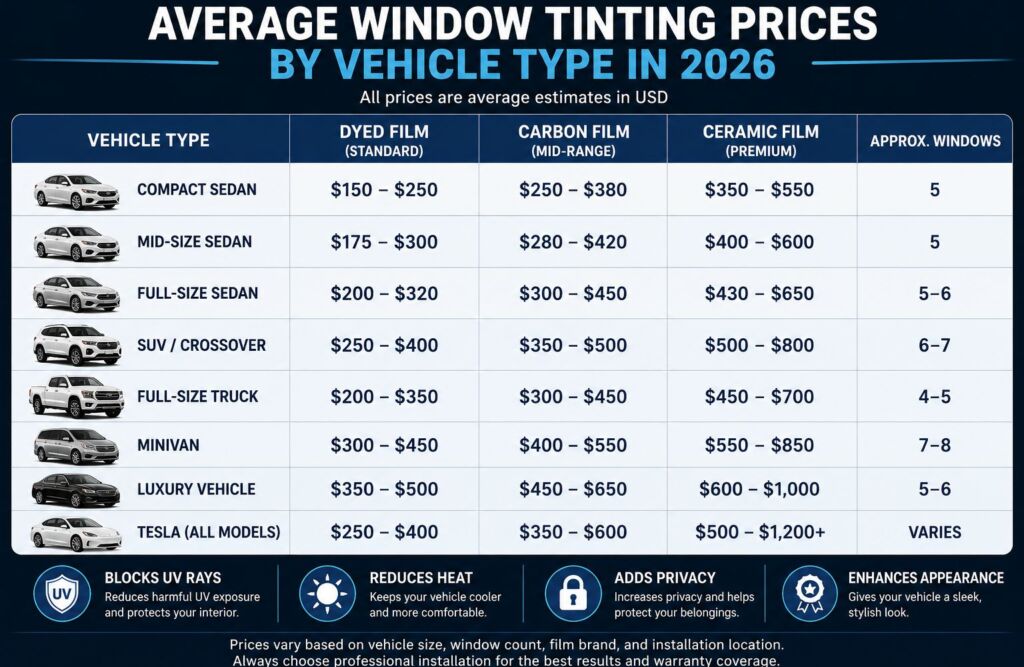
A few things worth knowing about these ranges. The low end of each column typically means a shop with lower overhead doing a simpler vehicle. The high-end features certified installers using premium-brand films such as XPEL XR Plus, LLumar IRX, or 3M Crystalline. You are not just paying for the film, you are paying for the cut quality, the warranty, and the installer’s ability to handle your specific glass geometry without errors that show up three months later.
San Antonio pricing tends to run 10 to 15 percent below what you would pay in Houston or Dallas for the same film and service level. That is the benefit of a high-density local market with real competition.
For pricing on car window tinting in Houston, see those location-specific guides. Film recommendations are similar, but labor rates and demand differ from those in the San Antonio window tinting market.
Film type is the single biggest driver of your total bill. The gap between a dyed film job and a ceramic job on the same sedan can be $300 or more. That gap is not arbitrary; each film tier is a fundamentally different product.
Dyed film uses a layer of dye embedded in polyester to absorb incoming light. It reduces glare and provides basic privacy. What it does not do well is block heat. The dye absorbs solar energy, but a good portion of that heat transfers into the cabin anyway. In a city where summer temperatures push past 100°F for weeks at a time, that is a meaningful limitation.
The bigger problem in San Antonio, specifically, is longevity. Dyed film fades. Under intense UV exposure, the dye breaks down, and the film shifts toward a purple hue. Most dyed-tint jobs in hot climates start showing visible color change within two to three years. By year four or five, the film often needs full replacement. For a vehicle you plan to own long-term, the math does not favor the cheap route.
Dyed film makes practical sense in one situation: you are on a short lease, and you want some privacy and a cleaner look without spending serious money. Otherwise, it is worth stepping up.
Carbon film is the practical middle ground that most daily drivers land on when they want real performance without the premium ceramic price. Carbon particles replace the dye layer, which means no fading, no purple shift, and substantially better heat rejection than dyed film. It also has no metallic content, so there is zero interference with GPS, phone signal, or toll transponders.
Carbon tint holds its color for the life of the vehicle and rejects significantly more infrared heat than dyed film. For a sedan or truck that you drive every day and park outside regularly, carbon is a defensible choice. The main reason to upgrade from carbon to ceramic is if heat rejection is a top priority in an SUV, a Tesla, or a vehicle where rear passengers are baking or if you want a manufacturer-backed lifetime warranty.
Ceramic film uses nano-ceramic particles that block both UV radiation and infrared heat without relying on metal or dye. Quality ceramic from brands like XPEL XR Plus, LLumar IRX, or 3M Crystalline blocks up to 99% of UV rays and rejects 50 to 80% of infrared heat. The difference in cabin temperature on a parked vehicle is real and noticeable.
There is a second reason ceramic matters in the San Antonio market beyond comfort: durability. Ceramic film from a reputable manufacturer carries a lifetime warranty against bubbling, peeling, fading, and color change. If you buy and install a certified XPEL or LLumar product through an authorized shop, that warranty transfers to a new owner when you sell the vehicle. That has actual resale value.
One caveat worth naming: not every shop that quotes ceramic is quoting the same product. Mid-tier “ceramic” films from off-brand manufacturers exist at lower price points, and they do not perform the same way. Before you book, ask the shop which specific brand and product line they are installing. A reputable shop will answer that question without hesitation.

Tesla tinting is its own category. The glass surface area on every Tesla model is substantially larger than on comparable non-Tesla vehicles. The curves are more aggressive, the stakes around sensor placement are higher, and the film choice carries consequences that do not apply to a standard sedan. We tint Teslas regularly in San Antonio, and the questions we get most often come down to three things: which film, how much, and what to watch out for.
Before getting to pricing, one rule applies to every Tesla without exception. Do not use metallic or metalized window film on a Tesla. Metallic tint contains metal particles that interfere with radio frequency signals. On a Tesla, that means degraded GPS accuracy, weaker cellular connection for over-the-air software updates, and potential interference with Autopilot and Full Self-Driving sensor communications. The film does not brick the car, but it creates real functional problems on a vehicle that depends heavily on wireless connectivity.
Carbon film is acceptable. Ceramic film is the correct choice for Tesla owners who want maximum performance. The cost premium over carbon is justified on a $45,000 to $90,000 vehicle.
Every Tesla uses external cameras for Autopilot. The B-pillar cameras, fender cameras, and the camera zone behind the rearview mirror housing must remain untinted. A shop that has worked on Teslas knows exactly where these zones are. A shop that has not applied film in places that obscure a camera will discover the first time a warning appears on your screen. Ask directly whether the installer has worked on your specific model before booking.
The Model 3 is the most straightforward Tesla to tint. The rear windshield is large but flat compared to the Model Y, and the side windows are conventional. Most owners in San Antonio run 35% VLT on rear sides for a privacy look that complies with Texas law on the fronts. Front side windows need to stay above 25% combined VLT. More on that in the Texas law section below.
A full ceramic job on a Model 3 in San Antonio runs $500 to $750, depending on film tier. Budget an additional $150 to $250 if you want a clear ceramic strip on the windshield.
The Model Y is the trickiest standard tint job we do. The rear roof glass panel is enormous and curves significantly from the windshield edge to the back of the cabin. That curve requires a heat-shrinking technique and experience with this specific panel; not all shops have it. If a shop quotes you a Model Y job without mentioning the roof separately, ask whether their quote includes it. Many don’t.
The roof panel itself runs $200 to $400, depending on film grade. At 70% VLT ceramic, the roof looks nearly identical to the factory glass but blocks a significant portion of infrared heat. In the rear seats on a July afternoon in San Antonio, the difference is substantial.
Full side and rear ceramic without the roof: $600 to $850. Including the roof with ceramic: $800 to $1,200, depending on film brand and installer.
The Model S and Model X involve more glass surface area than the Model 3 and Model Y, which pushes material costs higher. The Model X adds Falcon Wing doors, which require careful handling during installation to avoid film damage when the doors cycle. Panoramic roof options on both models add installation time. Expect the higher end of the ceramic price range for either of these vehicles.
The Cybertruck has a dramatically raked front windshield that is one of the largest pieces of automotive glass currently in production. The visor strip at the top of the windshield is one of the most popular add-ons for Cybertruck owners because the forward-raked angle sends a significant amount of direct sun into the front cabin. Side glass is relatively straightforward. The size of the windshield drives the material cost up compared to conventional trucks.

If you call three shops in San Antonio and get three different numbers, the reasons almost always come from these variables.
Film brand and tier. A shop using XPEL XR Plus or LLumar IRX charges more than a shop using unbranded ceramic film from a distributor. Both can say “ceramic” in their quote. The performance difference is real.
Glass complexity. Flat rectangular windows install faster than curved glass. Steeply curved rear windows on SUVs, panoramic roofs, and frameless windows on luxury vehicles add labor time. A shop that quotes a flat rate for “any SUV” is either padding the easier jobs or cutting corners on the harder ones.
Window count. The front two windows only run $100 to $200 on most vehicles. A full vehicle is obviously more. The price per window drops when you do more at once, so a full job is usually better value than coming back to add windows later.
Old tint removal. Removing existing tint adds $50 to $150, depending on the age and condition of the adhesive. A film that has been baking in Texas heat for five years and has fused to the glass takes considerably longer to remove cleanly without damaging defroster lines.
Installer certification. Authorized dealers for XPEL, LLumar, and 3M pay licensing fees and meet training standards in exchange for the ability to file manufacturer warranty claims. That adds to their cost structure. It also means if your tint develops an issue in year seven, you have a real warranty path.
RV and specialty vehicles. Motorhomes and Class A RVs involve far more glass than any passenger vehicle and sometimes require access equipment for taller rooflines. RV window tinting in San Antonio is priced separately from the vehicle table above. Call for a dedicated quote based on your specific coach size and window count.
Texas tint law sits in the Transportation Code Section 547.613. The measurement that matters is Visible Light Transmission, the percentage of light that passes through the glass. A higher percentage means a lighter tint. A lower percentage means darker.
The rule that catches the most drivers off guard is the combined VLT calculation. When an inspector measures your tint, the meter reads through both the window film and the factory glass together. Factory glass on most vehicles is around 70% to 75% VLT. If you install a 35% film on top of 70% factory glass, your combined reading is approximately 24.5%, which fails inspection.
That is not a fringe scenario. It comes up regularly. The fix is simple: a good installer measures your factory glass before recommending a film percentage. If your factory glass reads 75%, a 35% film brings your combined VLT to about 26%, which clears the 25% threshold with a small buffer. Riding the edge at exactly 25% is not wise either, since tint meters have minor variance and film can read slightly darker during the curing period.
Most shops in San Antonio recommend 30% to 35% on front windows as a practical standard. That keeps you clearly inside the legal limit while still providing meaningful glare reduction. Rear windows can go as dark as you want — 5% limo tint on rear side windows is fully legal in Texas.
Medical exemptions are available. If a physician certifies a medical need for darker front-window tint, you can carry a signed statement in the vehicle and present it during inspections or traffic stops.
If you are comparing tint jobs across Texas, the laws are the same statewide. Our car window tinting Houston page covers the same legal framework with local pricing context.
A few additional services come up on a regular basis. None are required, but several are worth understanding before you finalize a quote.
Add-On | Typical Cost | What to Know |
Windshield visor strip | $50 – $100 | Top 5 inches only. Legal in Texas. |
Full windshield ceramic (clear 70% VLT) | $150 – $300 | Blocks heat and UV with no visible darkening. |
Panoramic / sunroof tint | $150 – $400 | Tesla, BMW X5, Audi Q7, etc. Price varies by panel size. |
Old tint removal | $50 – $150 | Higher end if the adhesive is degraded or film is old. |
Front 2 windows only | $100 – $200 | Driver and passenger side. |
RV / motorhome | Call for quote | Window count and size determine price. |
The full windshield ceramic option deserves a mention. At 70% VLT, the film is nearly invisible; it looks identical to stock glass. But the nano-ceramic layer still blocks a meaningful amount of infrared heat coming through the front of the vehicle. On a vehicle that spends most of its day in direct sun, this is one of the higher-value additions per dollar spent.
The panoramic roof add-on matters most for Tesla owners and SUV drivers with large glass roofs. The roof is often the biggest single source of solar heat gain in a vehicle. Addressing the sides and rear while leaving the roof untouched produces noticeably uneven results on a hot afternoon.
The price you pay for car window tinting in San Antonio is mostly a function of two decisions: film type and who installs it. Every other variable- vehicle size, window count, and add-ons, adjust the number, but those two decisions set the floor and ceiling.
On film type: the San Antonio heat genuinely separates dyed and carbon film from ceramic over a multi-year ownership period. If you plan to own your vehicle for three or more years, the ceramic premium is a reasonable investment. If you are turning the car over in 12 months, carbon is a solid middle ground.
On installer: ask which specific film brand and product line they carry. Ask whether they have worked on your vehicle type. Ask about the warranty, what it covers, how long it lasts, and whether it transfers. Shops that have good answers to those questions are worth paying for.
At Beat The Heat Window Tinting, our window tinting San Antonio team works on everything from compact daily drivers to Tesla Model Y panoramic roofs to full-size RVs across the area. Get in touch for a quote on your specific vehicle, and we will explain exactly which film makes the most sense for your setup, what it costs, and why.
What is driving your tinting decision right now? Heat, privacy, or something else? Let us know, and we can point you toward the right setup for your situation.