
Menu
Close
Close
You’re sitting in a parking lot comparing your friend’s blacked-out windows to your stock glass. His car looks better, stays cooler, and offers complete privacy. You ask what percentage he’s running. “Five percent all around,” he says. “Never had a problem.”
Then you talk to someone else who got pulled over twice in six months for the same tint. Another friend failed the state inspection and had to strip everything off. Someone else swears 20% is the magic number that never causes issues.
Texas window tint laws can be confusing for drivers because there’s a significant discrepancy between what’s written in the law and what people actually do. Add in conflicting advice from tint shops, inspection stations that enforce differently, and police who may or may not care, and you’ve got a recipe for expensive mistakes.
This guide from Beat The Heat Window Tinting explains what’s actually legal in Texas, what percentage passes inspection reliably, and what really happens when you choose technically illegal tint. No sales pitches, no dodging the hard questions.
Here’s what we’re covering: the exact legal limits for every window on your vehicle, why those percentages matter differently depending on where you drive and what you drive, and the real enforcement patterns across Texas.
You’ll get straight answers on whether tinting with 5%, 15%, 20%, 30%, and 35% opacity is legal on front windows, rear windows, and windshields. We’ll explain what actually happens at inspection stations, what triggers traffic stops, and how to balance privacy with practicality.
Most importantly, you’ll understand the trade-offs. Darker isn’t always better. Legal doesn’t always mean ideal. And what works for someone else might create problems for you based on your daily routine, vehicle type, and where you live in Texas.
The goal isn’t to tell you what to do. It’s to give you enough real information to make a smart choice that won’t cost you tickets, inspection failures, or the hassle of removal.
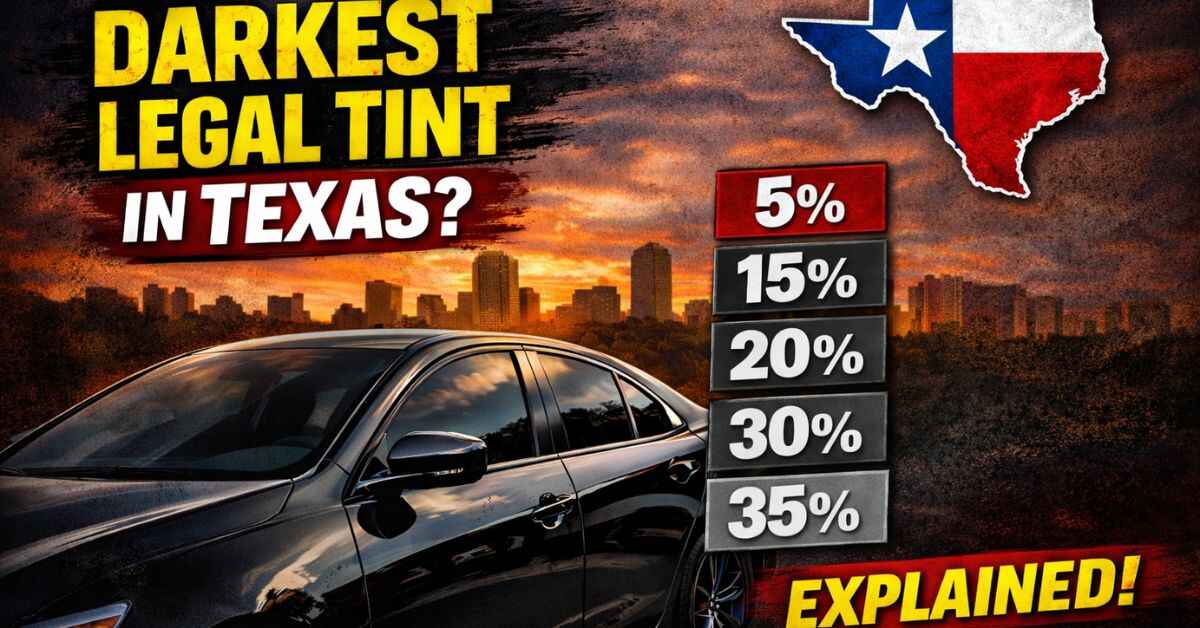
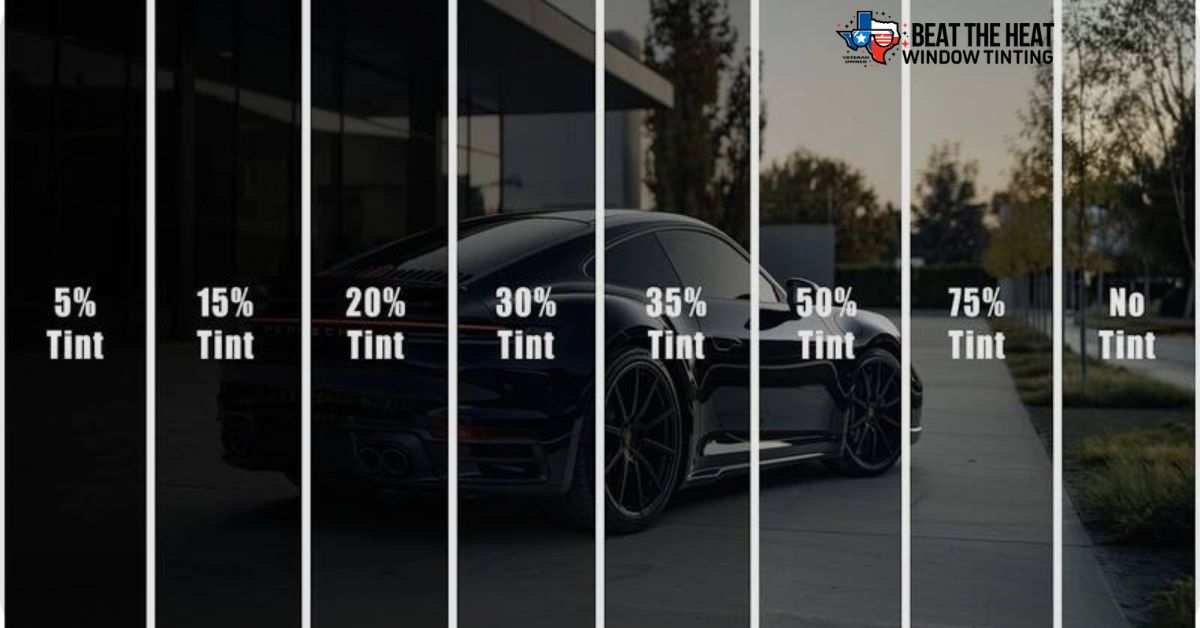
Texas uses Visible Light Transmission (VLT) to measure the darkness of tint. VLT is the percentage of visible light that passes through your windows. Lower numbers mean a darker tint.
A 5% VLT lets only 5% of light through, making windows nearly black. A 50% VLT allows half the light to pass through, resulting in a lightly tinted appearance. Factory glass on most vehicles is around 70–80% VLT before any aftermarket tint is applied.
This matters because Texas law sets minimum VLT requirements for different windows. When a cop or inspector measures your tint, they’re checking whether enough light passes through.
Many drivers misunderstand how factory tint affects legal limits. Your vehicle probably came with factory-tinted glass, especially on rear windows. This is glass with pigment added during manufacturing, not film applied afterward.
Texas law doesn’t give you an extra allowance for factory tint. If the legal limit is 25% on front side windows, that means total VLT, including factory tint, must be 25% or higher. You can’t add 25% film to a factory, 70% glass, and claim compliance.
When you stack aftermarket film over factory tint, the percentages multiply, not add. A 35% film on 70% factory glass results in roughly 24.5% total VLT (0.35 × 0.70 = 0.245). This catches people off guard at inspection.
The Texas Department of Public Safety sets vehicle tint standards, but enforcement varies dramatically. State inspections check tint compliance annually. Traffic stops may or may not result in tint tickets depending on the officer and the circumstances.
Inspection stations use tint meters to measure VLT. Some stations are strict, failing anything below legal limits. Others are lenient, passing borderline tint or not checking at all. This inconsistency creates confusion about what’s actually acceptable.
Police typically don’t pull drivers over solely for tint unless it’s extremely dark or they’re looking for another reason to initiate a stop. However, tint can be added to other violations, turning a warning into a citation.
Front side windows: Must allow more than 25% of light through. This means 25% VLT or higher. Practically, most shops recommend 30–35% to ensure passing inspection with a buffer.
Back side windows: Any darkness allowed. You can legally install 5% limo tint on the rear side windows of a sedan.
Rear window: Any darkness allowed. Complete blackout is legal.
Windshield: Only allowed above the AS-1 line (typically top 5 inches) or top 5 inches, whichever is lower. No tint below that point except factory tint.
The rules are identical. Texas doesn’t distinguish between vehicle types for tint regulations. This surprises drivers who assume SUVs get more flexibility.
Whether you drive a Honda Civic or a Chevy Tahoe, front side windows must stay above 25% VLT. Rear windows can be any darkness.
Texas law states front windows must allow “more than 25%” light transmission. This means 25.1% passes, but 25.0% technically fails. In practice, most inspection stations and officers allow 25% exactly, but some fail it.
This is why smart installers recommend 30% or 35% for front windows. The buffer accounts for measurement variations, film aging, and strict inspectors.
No, 5 percent tint is not legal on front side windows in Texas. It’s legal only on the rear side windows and the rear windshield.
Five percent tint in Texas is called limo tint because it’s nearly opaque. From the outside, you can’t see into the vehicle at all. From inside during the daytime, visibility is manageable but noticeably dimmer.
You can legally run 5% on:
Many Texas drivers run 5% all around anyway, accepting the risk. They pass inspection by temporarily removing the front window tint, switching to a lenient station, or finding shops that don’t check properly.
Driving with 5% tint at night is challenging. Backing up becomes difficult without relying entirely on cameras. Lane changes require extra caution because side visibility is severely limited.
Rain makes it worse. At night in rain with 5% tint, you’re essentially guessing what’s beside and behind you unless you have excellent mirrors and cameras.
Window tint ticket Texas fines for illegal front window tint range from $20 to $275, depending on the jurisdiction and the officer’s discretion. Most are fix-it tickets, meaning you can avoid the fine by proving you removed the illegal tint.
The bigger risk isn’t tickets, it’s inspection failure. Every year, you’ll face the choice of removing tint temporarily, finding a lenient shop, or risking driving without a valid inspection sticker.
No, 15 percent tint is illegal on front side windows. It’s legal on rear windows.
Many drivers who choose car window tinting prefer 15% because it balances privacy with functionality. It’s dark enough to hide interior contents and passengers, but light enough for safer driving at night.
The enforcement risk is lower than 5% but still present. Police can easily identify 15% tint as illegal during daytime stops. Inspection stations will fail it unless they’re lenient or you have an arrangement.
If privacy is your primary goal, 15% delivers strongly. Daytime privacy is nearly complete. Even at night with interior lights on, seeing inside requires standing very close to the window.
However, you’re trading legal compliance for privacy. Some drivers find this worthwhile. Others prefer legal tint with window shades for temporary privacy.
No, 20 percent tint is not legal on front side windows. The legal minimum is 25% VLT, and 20% falls below that threshold.
Twenty percent tint used in auto window tinting is extremely common because it’s a middle ground. It’s darker than the legal 25–30% but lighter than the aggressive 5–15% options. Many drivers assume it’s close enough to legal that it won’t cause problems.
Legally, no. Practically, 20% causes fewer issues than darker options. Some inspection stations let it slide, especially if you’ve been a regular customer. Others strictly fail it.
Police rarely stop drivers solely for 20% tint unless paired with other violations or the car matches a description. It’s dark enough to notice but not obviously illegal at a glance, like 5% is.
Night visibility with 20% is acceptable for most drivers. You’ll notice reduced brightness, but you can still see clearly with headlights and street lighting. Bad weather reduces visibility more significantly.
At inspection, 20% usually fail when checked with a meter. Your options are finding a station that doesn’t check carefully, temporarily removing front tint, or switching to legal percentages.
Twenty percent works best for drivers who:
It’s not recommended for drivers who need guaranteed inspection passage, drive frequently at night in bad weather, or have prior tint violations.
Yes, 30 percent tint passes Texas front window requirements. It exceeds the 25% legal minimum, providing a comfortable buffer for inspection.
Thirty percent tint in Texas is what most professional installers recommend for daily drivers who want legal tint with meaningful benefits.
Thirty percent offers:
The 5% buffer above the legal minimum accounts for measurement variations and film quality differences. Even if the film measures slightly darker than advertised, you’ll likely still pass inspection.
Thirty percent tint blocks significant solar heat, especially with ceramic film technology. You’ll notice cooler interiors on hot Texas days, though the difference isn’t as dramatic as with darker tints.
The real benefit is consistency. Legal tint that you can keep on your windows year-round performs better than illegal tint that you remove for inspection and reinstall afterward.
Thirty percent rarely causes inspection problems. Stations that check tint will pass it. Stations that don’t check will pass it. You’re not gambling or looking for lenient inspectors.
This reliability matters more than most drivers realize until they’ve dealt with inspection failures and removal costs.
Yes, 35 percent tint is completely legal on front windows in Texas and is the safest, most universally compliant choice.
Thirty-five percent tint in Texas is what cautious drivers choose. It’s light enough that no inspector or officer will question it, yet dark enough to provide real benefits.
Thirty-five percent stays well above the 25% legal minimum. This buffer means:
From outside, 35% is noticeably tinted but not dark. You can see into the vehicle with effort during the day, clearly at night with interior lights on.
For front side windows, 35% is the gold standard for compliance. You’ll never face tint-related tickets or inspection failures. This matters for drivers who can’t afford annual tint removal and reinstallation.
The peace of mind is valuable. You’re not checking your rearview mirror constantly, worrying about the police. You’re not researching lenient inspection stations. You just drive.
If you need guaranteed legal compliance, maximum visibility, and reasonable heat rejection, 35% is the answer. It’s ideal for:
The trade-off is less privacy and heat blocking than darker options. But you keep it forever without legal concerns.
Texas’s windshield tint law is stricter than the side window rules. You can only tint the top portion of your windshield.
The AS-1 line is marked on most windshields by the manufacturer. It’s typically 4–6 inches from the top of the glass. Texas allows tint above this line or in the top 5 inches, whichever is lower.
Practically, this means you can install a 5–6 inch tint strip along the top of your windshield. This blocks sun glare during morning and evening driving without obstructing visibility.
Any tint extending below the AS-1 line or below 5 inches is illegal. This includes light tint, ceramic films, or any aftermarket application.
Some drivers believe ceramic tint has different rules because it’s clearer than dyed film. This is false. Texas law regulates tint placement and darkness regardless of film technology.
You can install ceramic film in the legal windshield area, and it performs excellently for glare reduction.
Mistake 1: Extending the strip too far down, covering 8–10 inches instead of the legal 5 inches. Inspectors and officers measure this.
Mistake 2: Adding tint over factory windshields that already have a tinted strip, creating a darker band that’s too low on the glass.
The safest approach is professional installation from Beat The Heat Window Tinting that specifically follows Texas windshield tint regulations. DIY windshield strips frequently violate placement rules.
State inspection stations in Texas are required to check window tint compliance on front side windows. Rear windows are rarely checked since any darkness is legal.
Most inspectors use a handheld tint meter. They place the device against your front side window and take a reading. If it shows more than 25% VLT, you pass. If it reads 25% or below, you fail.
Some stations skip tint checks unless the windows are obviously dark. Others check every vehicle regardless of appearance. You can’t predict which type you’ll encounter.
Texas has thousands of inspection stations with varying enforcement standards:
Strict stations fail anything measuring 25% or below, enforce windshield rules carefully, and won’t pass vehicles with obviously illegal tint even without measuring.
Lenient stations may not check tint at all, pass borderline readings, or overlook minor windshield violations.
Standard stations check tint on obviously dark windows, but trust that lightly tinted windows are probably legal.
Finding a lenient station isn’t hard, but depending on one is risky. If they close, change ownership, or get stricter, you’re stuck scrambling for inspection.
Drivers often argue with inspectors, claiming their tint is factory and therefore exempt. This doesn’t work. Texas law applies to total VLT regardless of whether the tint is factory, aftermarket, or both.
Some vehicles come from the factory with front windows below 25% VLT. These technically violate Texas law as sold, though enforcement is rare because manufacturers certify compliance. Adding any film to these windows makes them obviously illegal.
5% tint: Nearly black. Daytime interior visibility is acceptable but noticeably dimmer. Night visibility is severely reduced. Backing up and changing lanes requires extreme caution.
15% tint: Very dark. Daytime visibility is good from inside. Night driving is manageable with good mirrors and cameras, but challenging in rain or unlit areas.
20% tint: Dark but functional. Daytime visibility is excellent. Night visibility is acceptable in most conditions, but reduced in heavy rain or on poorly lit roads.
30% tint: Moderate darkness. Daytime and night visibility remain very good. Most drivers adapt within minutes and notice minimal reduction in visibility.
35% tint: Light to moderate. Visibility impact is minimal. Some drivers barely notice they have tint after the initial adjustment period.
The visibility gap between percentages expands dramatically at night. A 5% tint that seems acceptable during the day becomes a safety concern after dark. A 35% tint that feels too light during the day proves ideal at night.
If you drive frequently at night, especially in rural areas without street lighting, choose a lighter tint. The extra visibility matters more than you’d expect.
Maximum privacy requires 5–15% tint, which is illegal on front windows. Moderate privacy comes from 20–30%, with 20% being illegal and 30% being legal. Light privacy from 35% is legal, but it doesn’t hide interior contents well.
You can’t have complete privacy and full legal compliance on front windows. Choose which matters more for your situation.
Thirty-five percent is ideal for daily drivers. It’s legal everywhere, passes any inspection, and provides meaningful heat rejection during summer commutes without compromising visibility during winter evening drives.
If privacy is your priority, install legal 30–35% on front windows and 5–15% on rear windows. This gives you maximum legal privacy. You can see out clearly from the driver’s seat while passengers and cargo remain hidden.
For maximum heat rejection, choose ceramic film from Beat The Heat Window Tinting in the 30–35% range for front windows. The ceramic technology blocks heat more effectively than dyed films of the same darkness. You get better temperature control while staying legal.
For rear windows where legality isn’t restricted, darker ceramic films in the 5–15% range provide exceptional heat blocking.
If you drive long distances, especially at night, prioritize visibility over darkness. Thirty-five percent is the clear choice. The visibility advantage during hours of highway driving outweighs any benefits from a darker tint.
Many drivers choose tint for the wrong reasons based on misconceptions about what different percentages actually deliver.
Tint darkness determines daytime privacy. At night with interior lights on, all tint becomes somewhat transparent. Even 5% tint allows people outside to see in when interior lights are brighter than exterior lighting.
If you need reliable nighttime privacy, you need more than tint. Window shades or curtains work better for vehicles used as sleeping or changing spaces.
Daytime privacy scales with darkness: 5% is nearly opaque, 15% is very private, 20–30% provides moderate privacy, 35% offers light privacy.
Heat rejection depends more on film technology than darkness. A quality ceramic 35% film can reject more heat than a cheap dyed 15% film.
The ceramic tint Texas market has exploded because ceramic technology blocks infrared radiation without requiring a dark tint. You get cooler interiors with better visibility.
For maximum heat control in Texas, choose ceramic film in whatever legal darkness you prefer. The technology matters more than the percentage.
Dyed films absorb heat through darkness. They’re cheaper but less effective per percentage point and fade faster in intense Texas sun.
Ceramic films reflect infrared radiation while allowing visible light through. They cost 40–60% more but deliver superior heat rejection, never fade, and don’t interfere with phone or GPS signals.
For Texas conditions, ceramic is worth the investment if you plan to keep the vehicle for several years.
This myth persists because enforcement is inconsistent. Yes, many Texas drivers run illegal tint without consequences. This doesn’t make it legal.
You’re gambling that you won’t encounter strict inspectors or officers who enforce tint laws. Many drivers win that gamble for years. Others get caught immediately. Your experience doesn’t change the law.
Factory tint absolutely counts toward legal VLT limits. Texas law regulates total light transmission regardless of how the tint was applied.
Tint shops that claim otherwise are either mistaken or deliberately misleading customers to make sales. Always measure total VLT, not just the aftermarket film percentage.
Most drivers with illegal tint won’t get pulled over solely for tint. However, tint can:
The absence of frequent tickets doesn’t mean the tint is consequence-free.
Citations for illegal window tint typically range from $20 to $275, depending on the jurisdiction. First offenses usually receive fix-it tickets, which are dismissible by proving correction.
Fix-it tickets require you to:
If you don’t fix it, the ticket remains on your record, and you pay the full fine.
Fix-it tickets give you time to correct the violation and avoid fines. Most tint violations are handled this way. You remove the tint, prove it, and the ticket disappears.
Standard citations can’t be fixed for dismissal. You pay the fine regardless. These are less common for tint but possible for repeat offenders or vehicles with multiple violations.
Officers typically enforce tint laws during:
Tint rarely causes isolated stops unless it’s extremely dark or the officer suspects other criminal activity.
The bigger enforcement comes from annual inspection, not the police. You’ll face this compliance check every single year you own the vehicle.
The darkest legal window tint in Texas for front side windows is anything above 25% VLT. Practically, 30–35% is recommended to ensure passing inspection with a comfortable margin.
For rear side windows and the rear windshield, any darkness is legal. You can install 5% limo tint on all rear windows without legal issues.
For windshields, tint is only legal above the AS-1 line or in the top 5 inches, whichever is lower.
If you want zero hassle, choose 35% for front windows and whatever darkness you prefer for rear windows. You’ll pass any inspection, never worry about tickets, and still get meaningful heat rejection and privacy.
If you want balanced darkness, choose 30% for front windows. It’s noticeably darker than 35%, stays safely legal, and provides better privacy and heat blocking.
If you’re willing to accept risk: Twenty percent or darker looks great and performs well, but requires managing inspection and accepting occasional enforcement risk.
The smart choice depends on your priorities. Legal compliance, maximum darkness, visibility, and privacy can’t all be maximized simultaneously. Figure out which matters most and choose accordingly.
Your friend with 5% tint all around might drive for years without issues. Or he might get stopped next week and spend $200 removing it all. Both outcomes are possible, and neither changes what’s actually legal in Texas.
The safest choice is 35% on front windows. It’s legal everywhere, passes any inspection, and provides real benefits. The next step down is 30%, which adds darkness while staying clearly legal.
If you choose a darker tint knowing it’s illegal, understand what you’re accepting: annual inspection challenges, possible tickets, and potential removal costs. For some drivers, the appearance and privacy are worth these risks. For others, the hassle isn’t worth it.
Before you make a decision based on what “everyone does” or what “you’ll never get caught for,” ask yourself: Is saving $100 by going darker worth the risk of $200 in removal costs, inspection hassles, and potential tickets every year you own the vehicle?
The best tint isn’t the darkest tint. It’s the tint that meets your needs without creating problems you’ll regret later. If you want expert guidance and a legal result that fits your vehicle, Beat The Heat Window Tinting helps drivers choose the right tint without risking inspections, tickets, or removal issues.
Yes, 5% limo tint is legal on the rear side windows and the rear windshield of any vehicle. It's illegal on front side windows and windshields except for the top 5-inch strip. Many drivers install limo tint on rear windows for privacy while keeping front windows legal.
Yes, you can receive a citation for a windshield tint extending below the AS-1 line or below 5 inches from the top. These are typically fix-it tickets. Windshield tint violations are less commonly enforced than side window violations, but still illegal.
No, ceramic tint must follow the same legal limits as any other tint type. The technology doesn't grant exemptions. However, ceramic tint can deliver better heat rejection at lighter, legal percentages compared to dyed films of the same darkness.
Yes, factory tint counts toward total VLT calculations. If your vehicle came with 70% factory tint and you add 35% film, the result is approximately 24.5% total VLT, which fails Texas requirements for front windows. Always calculate the combined VLT.
Thirty-five percent tint passes inspection most reliably. It stays well above the 25% legal minimum, accounting for measurement variations and strict inspectors. Thirty percent also passes easily with slightly more darkness. Anything below 25% will fail if measured properly.
Professional tint removal costs $25–50 per window, typically $100–200 for a full vehicle. DIY removal is cheaper but risks scratching the glass or leaving adhesive residue. Factor removal costs into your decision if choosing illegal tint.
Most officers don't carry tint meters during routine traffic stops. They make visual assessments. An extremely dark tint is obvious, but 20% might not trigger enforcement unless the officer is specifically looking for violations.
Texas does not offer medical exemptions for window tint darkness. Some states allow a darker tint for documented medical conditions requiring light sensitivity protection. Texas law provides no such exemption regardless of medical need.
Standard tint warranties cover defects and film failure, not removal for inspection or legal violations. If you install illegal tint and need to remove it for inspection, the removal costs come from your pocket. The warranty doesn't reimburse you.
The 5% difference between 20% and 25% is subtle visually but matters legally. At inspection, 20% fail and 25% pass. For most drivers, the practical difference in visibility and heat rejection is minimal, making legal compliance the deciding factor.
Texas requires compliance with Texas tint laws regardless of where the tint was installed. If your previous state allowed a darker tint, you must either accept potential inspection failure and tickets in Texas or remove the illegal tint.